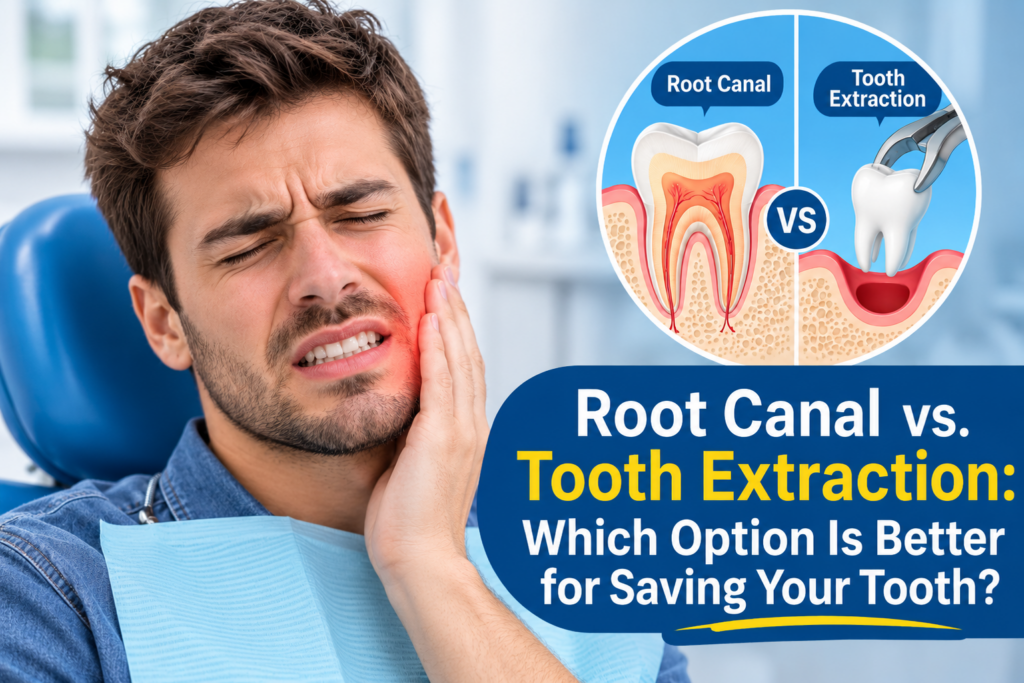
Quick Answer:
When a tooth becomes severely infected or damaged, your dentist may recommend a root canal or tooth extraction. Naturally, you may wonder which option is better, especially if you want to avoid unnecessary dental procedures. Understanding the differences between root canal vs. tooth extraction can help you make an informed decision about your oral health and long-term comfort. In most cases, a root canal is the preferred option when a natural tooth can be successfully restored. It removes infection from inside the tooth while preserving its natural structure. Extraction is generally recommended when the damage is too extensive to save the tooth or its supporting structures.
What Is the Difference Between a Root Canal and Tooth Extraction?
Both treatments address serious dental problems, but they work differently.
A root canal is an endodontic procedure that removes infected or inflamed pulp (the soft tissue containing nerves and blood vessels inside your tooth). The remaining space is cleaned, disinfected, filled, and sealed to preserve the natural tooth.
Tooth extraction, on the other hand, involves completely removing the affected tooth from its socket. Although this eliminates the damaged tooth, you may need an additional procedure, such as a dental implant or bridge, to replace it.
| Factor | Root Canal | Tooth Extraction |
|---|---|---|
| Main Purpose | Saves the natural tooth | Removes the affected tooth |
| Natural Tooth | Preserved | Removed |
| Treatment | Cleans and seals infected canals | Removes the entire tooth |
| Recovery | Usually mild temporary soreness | Depends on extraction complexity |
| Future Treatment | May require a crown | May require an implant or bridge |
| Long-Term Function | Maintains natural tooth function | Requires planning for the missing space |
Why Is Root Canal Treatment Usually Better for Saving Your Tooth?
Whenever possible, preserving your natural tooth offers several important advantages.
1. Maintains natural chewing ability
Your natural teeth are designed to work together. Saving an infected tooth helps maintain your normal bite and allows you to chew comfortably without immediately needing an artificial replacement.
2. Prevents neighboring teeth from shifting
When a tooth is removed, nearby teeth can gradually move into the empty space. This may affect your bite alignment and create additional dental concerns.
3. Preserves natural appearance
A successfully treated natural tooth maintains your existing smile without requiring an artificial replacement.
4. May reduce long-term treatment expenses
A root canal followed by an appropriate restoration may cost less overall than extraction combined with an implant or bridge. Actual costs depend on the tooth and treatment complexity.
When Is Tooth Extraction the Better Option?
Although saving natural teeth is generally preferred, a root canal is not appropriate for every situation.
Your dentist or endodontist may recommend extraction when:
The tooth has a severe fracture extending below the gumline.
Extensive decay has left insufficient healthy tooth structure.
The tooth has advanced periodontal disease with inadequate bone support.
The root is severely damaged and cannot be predictably repaired.
Previous treatment options have failed and the tooth has a poor prognosis.
Before deciding on extraction, consider getting an endodontic evaluation. Some teeth that initially appear difficult to save may still qualify for root canal retreatment or endodontic surgery.
Does a Root Canal Hurt More Than a Tooth Extraction?
No. Modern root canal treatment is performed using local anesthesia to numb the affected area. Most patients experience pressure or vibration rather than sharp pain during treatment.
Some tenderness afterward is normal and generally improves over the following days. Tooth extraction also involves anesthesia, but recovery can include swelling, soreness, and additional healing around the extraction site.
The actual experience depends on the severity of infection, treatment complexity, and individual healing response.
What Happens If You Choose Extraction Instead of a Root Canal?
Removing a tooth may resolve the immediate problem, but it can create a new restorative decision.
Depending on your situation, replacement options include:
Dental implants: Artificial tooth roots placed into the jawbone to support replacement teeth.
Dental bridges: Artificial teeth supported by neighboring teeth.
Partial dentures: Removable appliances that replace one or more missing teeth.
Leaving an empty space can affect chewing and allow neighboring teeth to shift. Your dentist can explain whether replacement is necessary and which option suits your oral health.
How Can You Know Which Treatment Is Right for You?
The best treatment depends on the condition of your tooth, surrounding bone, and overall oral health.
An endodontic evaluation may involve:
Reviewing your dental history and symptoms.
Examining the affected tooth and surrounding gums.
Taking digital dental X-rays or a 3D CBCT scan when indicated.
Evaluating cracks, infection, and remaining healthy tooth structure.
Discussing whether root canal treatment, retreatment, surgery, or extraction offers the most predictable outcome.
At LA Endodontics in Tarzana, CA, Dr. Gabreal Shamtoub uses advanced dental technology, including surgical microscopes and 3D CBCT imaging, to evaluate complex cases and identify opportunities to preserve natural teeth.
If you experience persistent tooth pain, swelling, or sensitivity, arrange an evaluation rather than waiting for the condition to worsen.
Conclusion: Root Canal vs. Tooth Extraction – Which Should You Choose?
When comparing root canal vs. tooth extraction, saving your natural tooth is generally the better choice when it has a predictable chance of successful treatment. Root canal therapy removes infection while preserving natural chewing function and appearance.
However, extraction may be necessary when the tooth cannot be restored safely. The right decision starts with an accurate diagnosis and a personalized treatment plan.
If you are experiencing dental pain or have been advised to remove a tooth, consult an experienced endodontist before making your decision. LA Endodontics in Tarzana, California, can help evaluate your options and determine whether your natural tooth can be saved.
Frequently Asked Questions
Is it better to get a root canal or have a tooth pulled?
If your tooth can be successfully restored, a root canal is generally preferable because it preserves your natural tooth. Extraction is appropriate when damage is too extensive to repair. An endodontist can assess the tooth and explain which treatment offers the best long-term outcome.
Can a badly infected tooth still be saved with a root canal?
Yes, many severely infected teeth can still be saved. Root canal treatment removes infected pulp, cleans the internal canals, and seals them. However, success depends on the remaining tooth structure, root condition, and supporting bone. Some complicated cases may require additional endodontic procedures.
Is tooth extraction cheaper than root canal treatment?
Extraction may initially cost less than root canal treatment, but the overall expense can increase if you replace the missing tooth with an implant, bridge, or denture. Comparing the complete treatment costs, including future restoration, provides a more realistic financial picture.
What happens if I don't replace an extracted tooth?
Depending on its location, leaving a missing tooth can affect chewing, allow neighboring teeth to shift, and change your bite. Your dentist can evaluate whether an implant, bridge, or partial denture is appropriate to restore function.
How long does a tooth last after root canal treatment?
A properly treated and restored tooth can last many years and sometimes a lifetime. Its longevity depends on the quality of the final restoration, oral hygiene, regular dental examinations, and avoiding excessive biting forces.
Can an endodontist save a tooth that another dentist recommends extracting?
Possibly. Endodontists specialize in diagnosing and treating problems affecting the inside of teeth. Advanced imaging, dental microscopes, root canal retreatment, and endodontic surgery may provide additional options for certain difficult cases. However, not every tooth can be saved.
When should I see an endodontist for a possible root canal?
Seek an evaluation if you experience persistent toothache, prolonged sensitivity to hot or cold, pain when biting, gum swelling, or a recurring pimple near a tooth. Facial swelling, fever, or difficulty swallowing requires urgent medical or dental attention.